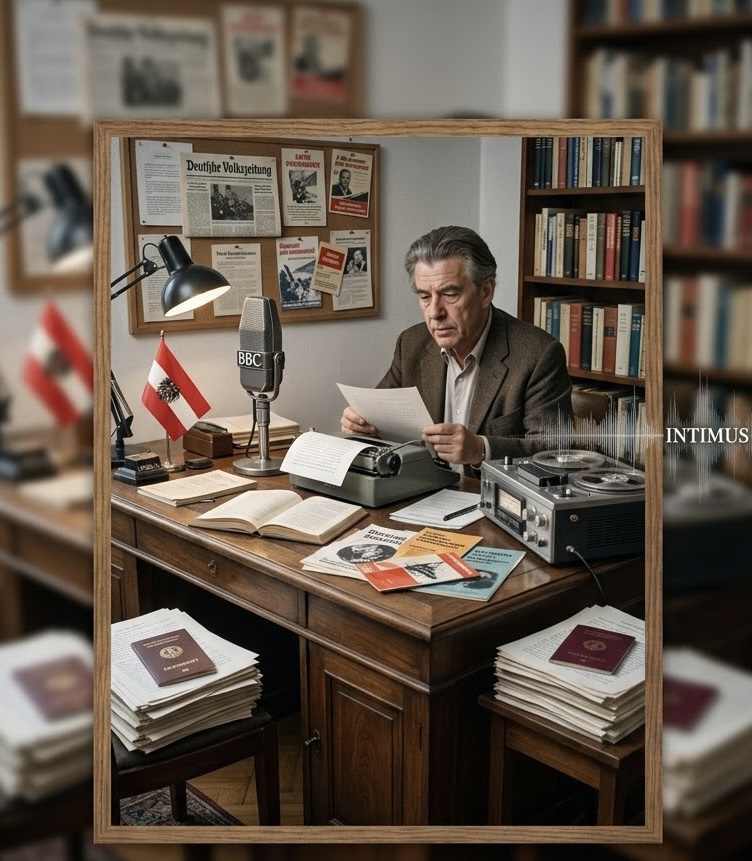
Erich Fried—born in Vienna, a poet, translator and outspoken public intellectual—has become the subject of a new scholarly edition that aims to make a neglected part of his radio work widely available. Under the direction of Roland Innerhofer, an edition of Fried’s "Intimus" contributions—BBC broadcasts addressed to listeners in the German Democratic Republic between 1953 and 1968—has been underway since 1 September 2025. The Austrian Science Fund (FWF) records the project as active, with a scheduled end date of 29 February 2028.
The undertaking situates literary editing within media history and exile studies. It is not merely the publication of texts but the systematic transcription, annotation and digital presentation of draft manuscripts and audio material. By assembling the scattered and partially unpublished sources, the project promises to render visible a dimension of Fried’s public interventions that has so far been accessible only patchily.
- Project leader: Roland Innerhofer; project aims to produce an edition of Erich Fried’s 'Intimus' BBC broadcasts to the GDR.
- Funding: Austrian Science Fund (FWF) Grant‑DOI 10.55776/PIN1483124; project status 'laufend' with start 01.09.2025 and planned end 29.02.2028; award sum recorded as €447,393.
- Archive holdings: ÖNB holdings include more than 320 Intimus typescripts, the total corpus comprises over 620 variant drafts and three audio recordings according to the project abstract.
- Collaborations: The project lists partners including the Austrian National Library, University of Vienna, University of Gießen and several German and UK research and broadcasting partners.
- Outputs: The project plans transcription, annotation and digital provision of texts and a selected commented volume; exact publication dates and detailed plans for public release of audio are not specified in public summaries.
The Source Base: Scope and Holdings
According to the FWF project entry and the ÖNB case files, the core of the edition is held by the Austrian National Library. The project documentation reports more than 320 Intimus typescripts in the ÖNB holdings and, across the total corpus, over 620 variant drafts of individual broadcasts. In addition, there are three audio recordings. These elements form the material basis for a critical edition: transcriptions of different versions, documented variant readings and scholarly annotations are planned to provide transparency on editorial choices.
For textual scholars, the high number of variants is especially valuable: it allows reconstruction of Fried’s drafting processes, the tracking of reworkings that respond to editorial constraints or political considerations, and a more exact assessment of how the broadcasts were shaped before and during transmission. The presence of audio material, albeit limited, offers a complementary source to compare spoken performance with extant manuscripts.
Content, Audience and Tone of the Intimus Broadcasts
Project summaries and sample editions indicate that the Intimus broadcasts combined literary commentary, cultural critique and philosophical reflection. They were explicitly aimed at listeners in the GDR and addressed topics ranging from literary life in East Germany to broader questions about intellectual responsibility and political solidarity in a divided Europe.
Journalistic framings that characterise Fried as a 'Kommunisten‑Versteher' (literally, a 'communist sympathiser' or 'communist‑understander') reflect an interpretive reception of these texts rather than a neutral catalogue entry. The archival evidence attests to Fried’s engagement with left‑wing positions and anticapitalist critiques, but it also shows his critical stance toward repressive or authoritarian tendencies. The edition’s material approach—presenting variants and contexts—allows scholars to map these nuances rather than subsume them under a single label.
Partnerships and Planned Outputs
The project is explicitly collaborative: the FWF entry names the University of Vienna and the Austrian National Library as central partners, and lists German and UK academic institutions such as the University of Gießen among collaborators. Broadcasting partners are also acknowledged, reflecting that the source materials originate in radio production and distribution networks.
Planned outputs include a digital scholarly edition and a curated printed selection with commentaries. The public project summaries do not, however, provide precise publication dates for the digital materials or a detailed timeline for access to audio files. Questions of rights clearance for broadcasts and recordings, and the editorial policy toward reproducing sound material, are matters that typically require dedicated negotiation and are not fully outlined in the public abstracts.
Research Implications: Exile, Media and Cold War Culture
If realized as described, the edition will have several implications. First, it supplies primary texts for scholarship on exile literature and the transnational media sphere of the Cold War. Second, it makes available evidence for how intellectuals addressed audiences across the Iron Curtain and how cultural commentary mediated political alignment and critique. Third, by making draft variants visible, the project allows researchers to analyse how rhetoric, argumentation and rhetorical positioning shifted in response to intended audiences or editorial constraints.
The edition is therefore positioned at the intersection of philology and historical inquiry. For historians of culture, the availability of annotated drafts and any accompanying production records will enable more fine‑grained reconstructions of transmission practices, censorship pressures and the rhetorical strategies used by exile intellectuals to retain credibility with diverse audiences while articulating political positions.
Remaining Uncertainties and Editorial Challenges
Despite the clear project framework, public documentation leaves open a number of practical and interpretive questions. The schedule for public release of digitised texts and audio material is not specified in the FWF entry; nor are the precise editorial selection criteria for the planned printed volume. Rights clearance for BBC archives and for possible third‑party material embedded in broadcasts could complicate full online availability of recordings.
Moreover, the more contentious interpretive claims—such as labeling Fried a 'communist sympathiser'—are matters for scholarly debate and contextual analysis rather than established fact. The edition will supply primary evidence to underpin such debates, but the definitive verdicts about Fried’s political positioning will depend on careful hermeneutic work that situates the broadcasts in relation to his wider oeuvre, correspondence and the political texture of Cold War broadcasting. In any case, the project enhances the empirical basis for these discussions by assembling and annotating material that has hitherto been dispersed.
IO SYNTHESIS
THREE-SOURCE ARTICLE ANALYSIS
Project leader: Roland Innerhofer; project aims to produce an edition of Erich Fried’s 'Intimus' BBC broadcasts to the GDR.
OPEN EVIDENCE ↗Funding: Austrian Science Fund (FWF) Grant‑DOI 10.55776/PIN1483124; project status 'laufend' with start 01.09.2025 and planned end 29.02.2028; award sum recorded as €447,393.
OPEN EVIDENCE ↗Archive holdings: ÖNB holdings include more than 320 Intimus typescripts, the total corpus comprises over 620 variant drafts and three audio recordings according to the project abstract.
OPEN EVIDENCE ↗✓ SOURCES AND DOCUMENTS
01 derstandard.at ↗02 derstandard.at ↗03 fwf.ac.at ↗Sources last checked · 30.08.2026, 18:34This article was written and checked by the ZEITUNG.IO newsroom. It is updated when new verified information becomes available.