The 2026 growing season across parts of Germany illustrated a trend climate scientists have warned about: hotter summers and prolonged low-precipitation periods are putting pressure on fruit production. Official statistics from the Federal Statistical Office (Destatis) published in August 2026 reported a drop in the apple harvest, explicitly linking the reduction to repeated heat waves and spring/summer drought. The impacts were particularly visible in regions where cultivation traditionally relied on rainfall rather than engineered irrigation.
For producers this has been a twofold problem: not only did volumes fall, but fruit quality also suffered. Increased instances of sunburn on skins and flesh, together with smaller, less juicy apples, led to downgrades at wholesale and processing stages. Agricultural advisories and regional reporting for 2026 have interpreted these developments as signs that the sector’s risk profile is changing and that extreme weather events of this type may become more frequent.
- Destatis reported a reduced apple harvest in August 2026, citing repeated heat waves and spring/summer drought as factors.
- Growers have increased use of hail/shade nets and emergency irrigation; technical guidance shows nets reduce sunburn but infrastructure is costly.
- The LVWO in Weinsberg conducts variety trials and irrigation advice; the new late‑flowering variety 'Mammut' has been tested in regional trials and introduced.
Immediate protective measures on farms
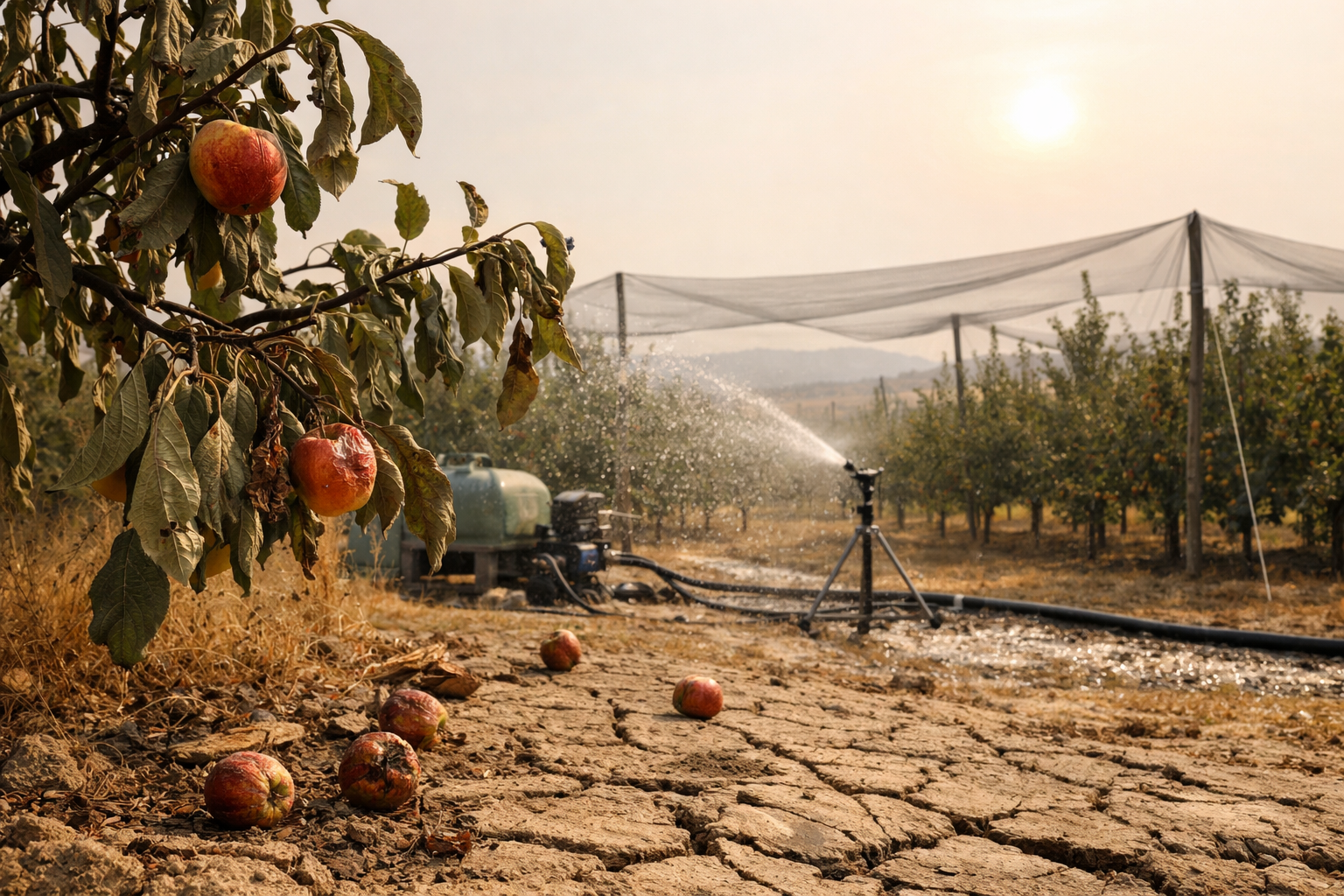
Growers responded rapidly with practical measures. The use of hail and shade nets over trees has expanded: these nets reduce direct solar radiation on the fruit and thereby reduce the incidence of sunburn. Technical trials and extension guidance indicate that nets can lower the temperature stress on fruit surfaces and improve the number of marketable apples.
Where water supplies allow, farms implemented targeted emergency irrigation: drip lines, mobile pumps and, in some cases, manual watering from canisters were used to protect vulnerable trees and fruit clusters. Coverage reports from SWR and regional broadcasters described these improvisations in detail. Such tactics are effective at small scale but are costly in labor and water and are difficult to scale across large orchards without proper infrastructure.
Research and new varieties as adaptation tools
Public research and trial stations are addressing longer-term adaptations. The State Teaching and Research Institute for Viticulture and Pomology (LVWO) in Weinsberg is active in variety trials and in producing practical guidance on irrigation timing and soil management. Its work focuses on identifying varieties with greater tolerance to heat and water stress and on integrating cultivation methods that reduce vulnerability.
One concrete outcome of regional breeding and testing is the recently introduced late‑flowering variety known as ‘Mammut’, which has been trialed for increased resilience to late frosts and heat spells. While new varieties can shift growing risk and broaden options for producers, researchers emphasise that varietal change is not a standalone solution if regional water supplies continue to decline. A combined approach of variety selection, soil conservation and water management is needed.
Infrastructure choices: storing water matters
Extension experts, including staff at LVWO, argue that emergency measures are necessary but insufficient. Their recommendations increasingly point toward investment in irrigation infrastructure: cisterns, retention basins and small reservoirs that can capture rainfall and release it during dry spells. Building such storage systems requires land use decisions, planning approvals and, crucially, capital — factors that are challenging for many mid‑size and small farms.
Legal and hydrological conditions differ across Germany. Groundwater extraction limits, permit systems and competing demands for water mean that storage proposals raise questions about ownership, access and regional coordination. Advisers suggest cooperative approaches — for instance, farmer associations or municipal‑level projects — to share the costs and operational burdens of storage facilities.
Economic implications for growers and buyers
The financial effects of lower yields and increased input costs are felt across the supply chain. Smaller or misshapen fruit typically fetch lower prices on the wholesale market; processing facilities can absorb some surplus but pay less than retail outlets. Combined with the extra expenses for nets, irrigation equipment and additional labor to implement emergency watering, many direct‑marketing farms face tighter margins.
For retailers and processors, the more volatile supply of high‑grade fruit forces adjustments in sourcing and inventory planning. Several buyers are discussing longer term contracts, increased sourcing flexibility and potential acceptance of a wider range of varieties or quality grades. Public funding and subsidy options have been proposed to support capital investments, but program availability and eligibility often vary by federal state and EU funding cycles.
What is established — and where uncertainty remains
What is clear from the available evidence is that 2026 delivered a tangible shock to apple production: Destatis reported a harvest decline, extension services and regional media documented increased sunburn and quality losses, and examples from farms show broader uptake of nets and emergency irrigation. Research institutions are actively testing new varieties like ‘Mammut’ and promoting water management strategies.
However, important questions remain unresolved. There is limited systematic, country‑wide data on the average per‑tree yield losses attributable specifically to heat versus other factors; specific figures cited by individual growers are best read as farm‑level estimates. The feasibility of large‑scale investments in storage depends on financing, legal frameworks for water use and the availability of suitable sites. Policymakers, researchers and producers must therefore work together to convert short‑term coping into regionally appropriate, long‑term adaptation strategies — an effort that will require measurement, planning and public support.
IO SYNTHESIS
THREE-SOURCE ARTICLE ANALYSIS
Destatis reported a reduced apple harvest in August 2026, citing repeated heat waves and spring/summer drought as factors.
OPEN EVIDENCE ↗Growers have increased use of hail/shade nets and emergency irrigation; technical guidance shows nets reduce sunburn but infrastructure is costly.
OPEN EVIDENCE ↗The LVWO in Weinsberg conducts variety trials and irrigation advice; the new late‑flowering variety 'Mammut' has been tested in regional trials and introduced.
OPEN EVIDENCE ↗✓ SOURCES AND DOCUMENTS
01 tagesschau.de ↗02 destatis.de ↗03 umweltbundesamt.de ↗Sources last checked · 26.08.2026, 14:01This article was written and checked by the ZEITUNG.IO newsroom. It is updated when new verified information becomes available.