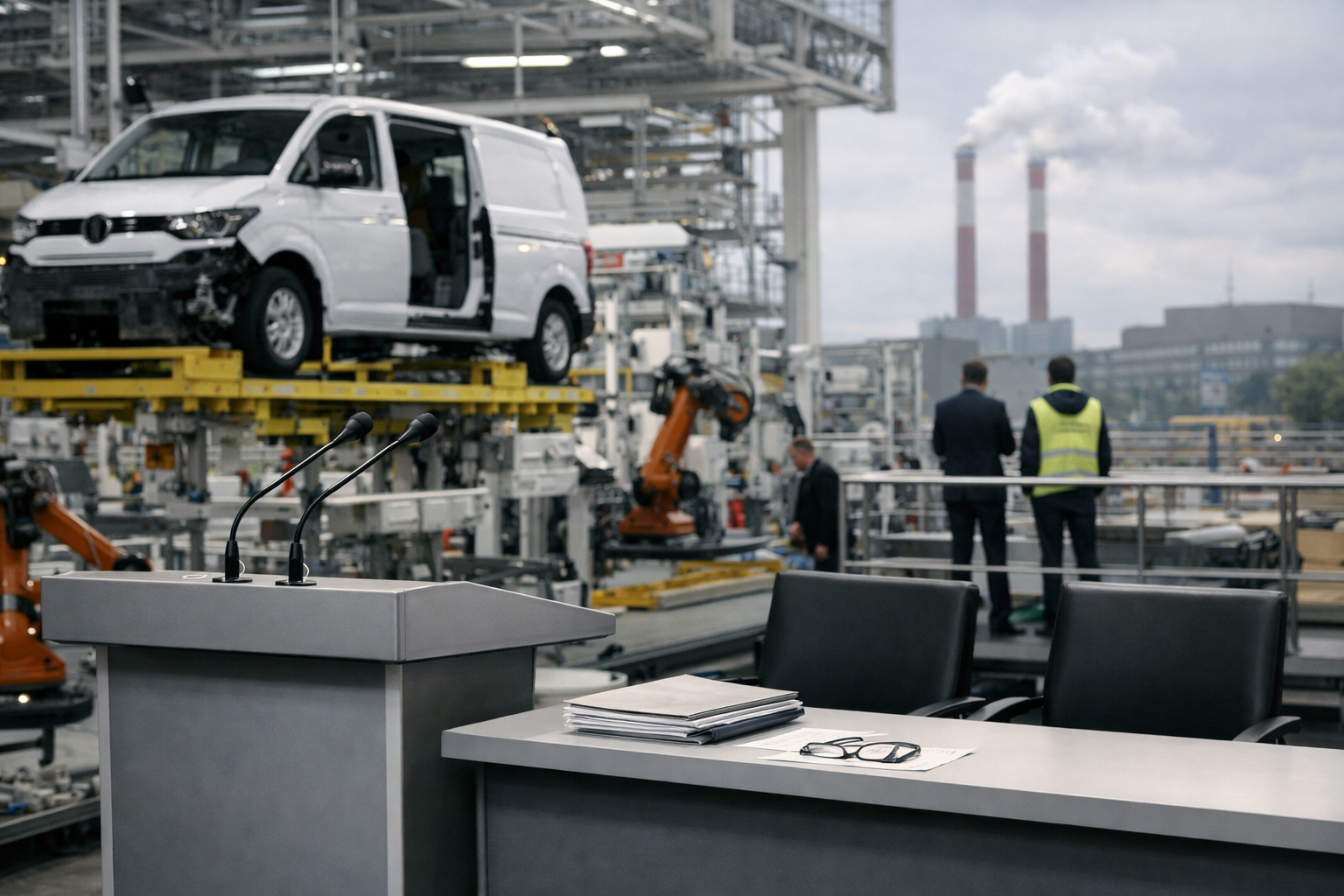
Daniela Cavallo, chair of Volkswagen’s central and group works council, visited the Volkswagen Commercial Vehicles site in Hannover‑Stöcken on the evening of 24 August. She was accompanied by Lower Saxony’s prime minister, Olaf Lies. The visit came immediately before a series of Betriebsversammlungen — companywide employee assemblies — where members of the executive board are scheduled to address the workforce about strategy and planned measures, according to reports by NDR, Tagesschau and Deutschlandfunk.
Cavallo used the occasion to press the management for clear commitments. The presence of a state political leader underlined the regional political stakes of the debate. The assemblies are intended as forums for direct exchange between the board and employee representatives at a time when the company is conducting internal reviews of costs and capacity.
- Daniela Cavallo visited the Volkswagen Commercial Vehicles plant in Hannover‑Stöcken on 24 August 2026, accompanied by Lower Saxony’s Prime Minister Olaf Lies (sources: NDR, Tagesschau, Deutschlandfunk).
- Cavallo told reporters and employees that negotiated job‑security protections must be upheld and said: “Wir haben eine Beschäftigungssicherung erkämpft…”, and warned that removing arrangements like phased retirement would prompt other measures (sources: NDR/Tagesschau/Deutschlandfunk).
- Media reporting has discussed possible group cost measures and scenarios including up to roughly 50,000 jobs and capacity adjustments of about 500,000 vehicles in Europe; these figures are reported scenarios, not newly announced management decisions.
What Cavallo said: job security and social protections
According to public-broadcaster reports, Cavallo rejected plant closures and insisted that previously negotiated protections for employees must be preserved. She was quoted as saying: “Wir haben eine Beschäftigungssicherung erkämpft und wir werden auch in Zukunft dafür kämpfen, dass Veränderungen sozialverträglich stattfinden.” The citation appears in NDR and Tagesschau coverage and has been carried by Germany’s national media.
She singled out measures such as phased retirement as examples of protections that should remain in place, warning that if such arrangements were withdrawn, "werden wir über andere Maßnahmen sprechen müssen," i.e. alternative measures would have to be considered. Cavallo also demanded “Zukunftsperspektiven” from the company leadership that go beyond mere cost reductions — in other words, concrete plans for plant utilisation, product strategy and investment.
Corporate context: announced reviews and reported scenarios
Cavallo’s intervention comes against the backdrop of a sharpening cost and efficiency programme signalled by Volkswagen’s CEO Oliver Blume and the executive board in recent weeks. Media reporting has circulated scenarios that include potential additional job reductions in the order of roughly 50,000 positions across the group and possible capacity adjustments in Europe equivalent to about 500,000 vehicles. These figures have been widely reported in national coverage and industry press but, at the time of Cavallo’s visit, had not been announced as binding decisions by VW.
The works meetings are significant because they provide employees and their representatives a direct channel for questioning and seeking commitments from management. For many workers the immediate questions concern which plants will be assigned future models and technologies, and how production volumes might change.
Standards and sites under discussion
Media coverage repeatedly named several German sites as being under scrutiny — notably Hannover, Emden, Zwickau and Neckarsulm. Each site faces different questions: some are in the midst of transitions to new vehicle architectures, others may experience shifts in demand or capacity utilisation. The repeated naming of these factories in reporting reflects public concern but does not equal a formal announcement of closures or model transfers.
Works councils, trade unions and regional politicians have been calling for clear, written commitments before any irreversible decisions are taken. Those commitments would typically concern investment plans, model allocations and social safeguards such as early retirement options, re‑training measures and compensation mechanisms.
Responses from unions and politics
IG Metall and local worker representatives welcomed Cavallo’s stance and stressed the need for socially acceptable solutions. Olaf Lies, the Lower Saxony prime minister, accompanied Cavallo in Hannover and underlined the state’s interest in securing local jobs. IG Metall representatives reiterated that negotiated protections — including phased retirement and employment‑security agreements — must not be put at risk.
Political actors can apply pressure through public engagement, negotiation and the potential use of regional economic instruments, including targeted support programs or conditional incentives. However, direct influence over corporate decisions is limited; such decisions rest with the company’s board and shareholders. Whether the state will propose specific measures or financial incentives in discussions with VW was not disclosed in the reporting.
Consequences, open questions and the near term
For employees the current situation combines a clear defence of existing protections with persistent uncertainty about the long‑term allocation of work within the group. The management’s forthcoming communications at scheduled works assemblies will be closely examined for any definitive commitments on investments and model assignments. The significance of Cavallo’s public demand lies less in an immediate change of course than in signalling that unions will contest any measures that undermine negotiated safeguards.
Open questions remain substantial: which plants would be affected if management pursues capacity reductions, and what timeframes are being considered? How would any reductions be implemented, and what compensation or mitigation would be offered? The reported figures circulating in the press — up to roughly 50,000 jobs and 500,000 vehicles of capacity in Europe — are scenarios discussed in the media and reflect the scale of potential adjustment, but they are not formal, newly announced decisions by Volkswagen as of the visit. The next concrete moments will be the works assemblies and, potentially, subsequent talks between IG Metall, state representatives and VW management aimed at securing clearer, binding agreements.
IO SYNTHESIS
THREE-SOURCE ARTICLE ANALYSIS
Daniela Cavallo visited the Volkswagen Commercial Vehicles plant in Hannover‑Stöcken on 24 August 2026, accompanied by Lower Saxony’s Prime Minister Olaf Lies (sources: NDR, Tagesschau, Deutschlandfunk).
OPEN EVIDENCE ↗Cavallo told reporters and employees that negotiated job‑security protections must be upheld and said: “Wir haben eine Beschäftigungssicherung erkämpft…”, and warned that removing arrangements like phased retirement would prompt other measures (sources: NDR/Tagesschau/Deutschlandfunk).
OPEN EVIDENCE ↗Media reporting has discussed possible group cost measures and scenarios including up to roughly 50,000 jobs and capacity adjustments of about 500,000 vehicles in Europe; these figures are reported scenarios, not newly announced management decisions.
OPEN EVIDENCE ↗✓ SOURCES AND DOCUMENTS
01 ndr.de ↗02 tagesschau.de ↗03 deutschlandfunk.de ↗Sources last checked · 26.08.2026, 13:54This article was written and checked by the ZEITUNG.IO newsroom. It is updated when new verified information becomes available.