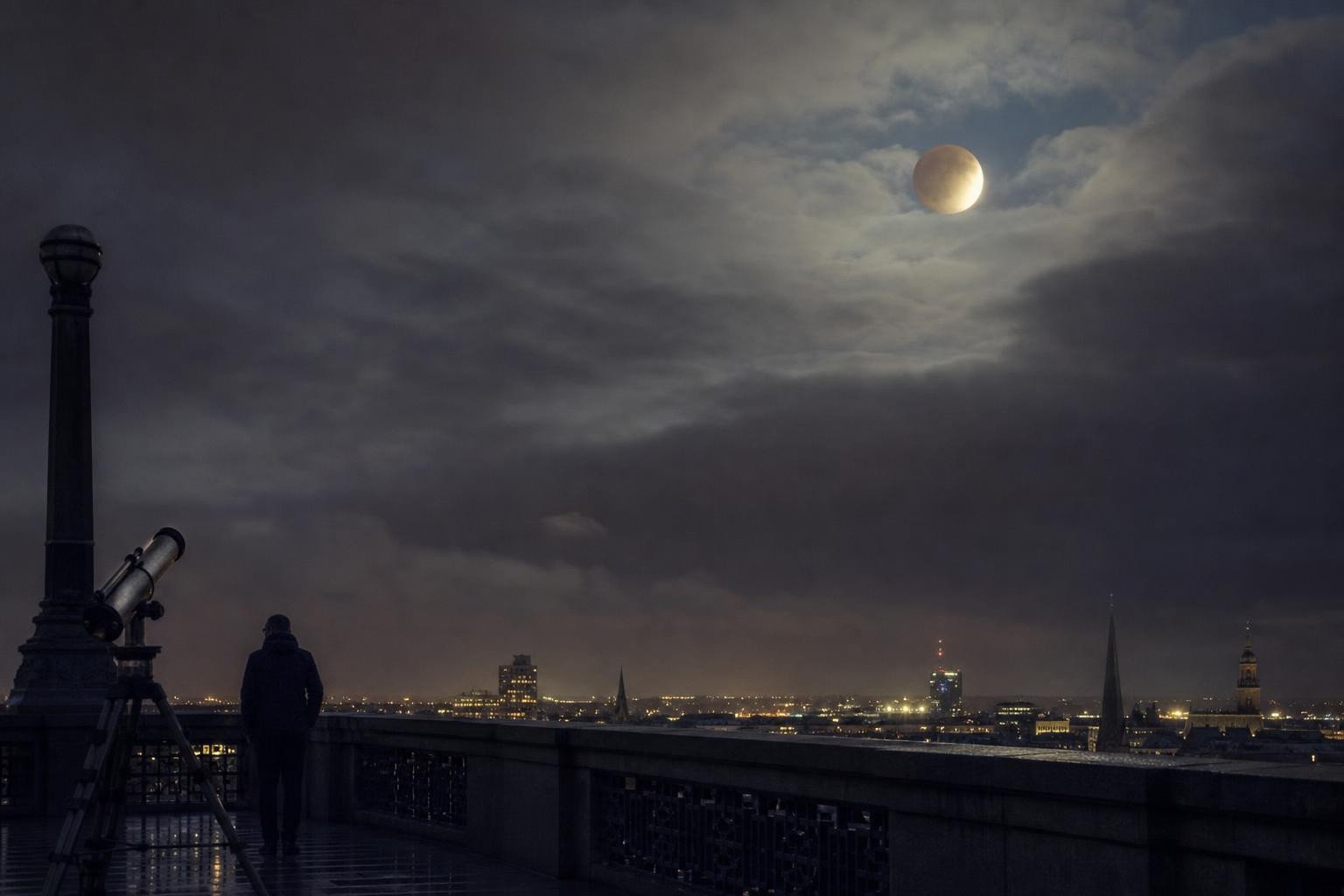
In the early hours of 28 August 2026, a partial lunar eclipse took place over Germany. Multiple reliable reports agree on the basic timeline: the Moon entered Earth’s umbral shadow and the partial phase began at roughly 04:33–04:34 Central European Time, with the maximum of the eclipse occurring around 06:12–06:13. Although the fraction of the lunar disk that was in shadow was high—regional reporting cited figures around 90 to 93.5 percent—widespread cloud cover prevented clear, widespread observation. Coverage by Tagesschau, NDR and dpa/Die Zeit all emphasized that thick clouds over broad swathes of the country dominated the viewing conditions.
The result was a contrast between a noteworthy celestial event by astronomical standards and a largely unseen spectacle for the general public. Planetariums and meteorological services had prepared information and viewing guidance in advance, but meteorological reality determined the practical outcome in most places.
- On 28 August 2026 a partial lunar eclipse occurred over Germany.
- Partial phase began at about 04:33–04:34 CET; maximum around 06:12–06:13 CET; moonset followed soon after in some locations.
- Coverage of the Moon by Earth's umbra reached over 90 percent, with regional reports citing approximately 93.5 percent at maximum.
- Widespread cloud cover, reported by the Deutscher Wetterdienst and regional media, largely prevented clear observations across much of Germany; only isolated local clearings were reported.
Timeline and technical details
The timetable for the eclipse is consistent across planetarium announcements and regional reporting. The partial phase began at approximately 04:33–04:34 CET when the Moon’s limb entered Earth’s umbra. The eclipse reached its maximum at about 06:12–06:13 CET; in several locations moonset or the onset of civil twilight followed shortly afterwards, narrowing the window in which observers could have seen the event.
These times were confirmed by planetarium schedules and referenced in regional coverage. That the maximum coincided closely with dawn in many places further reduced the opportunity to perceive the darkened lunar surface. For those attempting to document or observe the phenomenon, the precise timing required pre-planned setups, but such preparations could be rendered futile by intervening cloud cover or the approaching daylight.
Visibility and the role of weather
The primary reason most observers missed the eclipse was meteorological. The German Weather Service (Deutscher Wetterdienst, DWD) told national outlets that widespread cloud cover would likely prevent good observations in large parts of the country. Regional forecasts and weather models showed a broad cloud band across northern and central Germany, with especially dense clouds reported in the north. NDR reporting noted these conditions and cited local weather experts who confirmed the situation.
In the south, conditions were more mixed: some localities in Bavaria and parts of eastern Brandenburg recorded brief clearings that allowed transient glimpses of the lunar disc during the partial phase. Such sightings, however, were sporadic and not representative of nationwide conditions. For amateur astronomers and hobby photographers the combination of a late-night start, nearing dawn, and unpredictable cloud passages made effective observation a challenge: even a narrow cloud strip could obliterate the view entirely, and the briefness of any opening left little margin for error.
Astronomical context and significance
A partial lunar eclipse is a geometric event: Earth’s shadow falls across part of the Moon, darkening the exposed area. The 28 August event was notable in that a large fraction of the lunar surface—regional figures indicated roughly 90 to 93.5 percent—was immersed in the umbra at maximum, making it one of the more substantial partial eclipses of the year. Rainer Kresken, cited in regional reporting, highlighted the high coverage figure as a distinguishing feature.
From a scientific standpoint, lunar eclipses are relevant for education, amateur observation and occasionally for atmospheric studies. The colour and brightness of the eclipsed portion can carry information about Earth's atmospheric composition and dust content, because sunlight refracted and scattered through the atmosphere lights the shadowed lunar surface. However, these subtleties require clear observation and, ideally, calibrated instrumentation—both of which were limited by the prevailing cloudiness on Thursday morning.
Practical consequences for public outreach and observers
Planetariums, observatories and local astronomy clubs that had planned viewing events reported lower turnout or switched to indoor programming when outdoor observation proved impossible. Many institutions offered live streams, lecture-style briefings and explanatory material online to serve audiences who could not see the eclipse directly. Such digital alternatives have become a standard response when weather jeopardizes public skywatching events.
Enthusiast networks and amateur astronomer forums showed a mix of frustration and small successes: despite the widespread cloud cover, a handful of participants reported brief successful observations, often documenting them with timestamps and photographs. Regional media outlets cautioned that single snapshots are valuable but not necessarily indicative of the broader national experience; corroboration from time-stamped images or official regional station footage provides stronger evidence for localized clearings.
What is established and what requires further confirmation
What is firmly established by the converging reports of Tagesschau, NDR and dpa is the occurrence of a partial lunar eclipse on 28 August 2026, the timing of the partial phase (about 04:33–04:34 CET start and a 06:12–06:13 CET maximum) and the high degree of coverage of the Moon by Earth’s umbra (over 90 percent, with regional references to about 93.5 percent). It is likewise well supported that weather—specifically large-scale cloud cover—prevented broad visual observation in most of Germany.
What remains subject to local verification are the anecdotal clearings and single-location successes reported in some southern and eastern localities. Those accounts are consistent with the expected variability of cloud fields; however, they should be backed by time- and location-stamped images or by recordings from regional broadcasters (dpa/ARD affiliates) before being generalized. Overall, the event exemplified the simple reality that clear skies are as decisive for public astronomy as the astronomical geometry itself.
IO SYNTHESIS
THREE-SOURCE ARTICLE ANALYSIS
On 28 August 2026 a partial lunar eclipse occurred over Germany.
OPEN EVIDENCE ↗Partial phase began at about 04:33–04:34 CET; maximum around 06:12–06:13 CET; moonset followed soon after in some locations.
OPEN EVIDENCE ↗Coverage of the Moon by Earth's umbra reached over 90 percent, with regional reports citing approximately 93.5 percent at maximum.
OPEN EVIDENCE ↗✓ SOURCES AND DOCUMENTS
01 Tagesschau · Inland ↗02 tagesschau.de ↗03 tagesschau.de ↗Sources last checked · 28.08.2026, 07:34This article was written and checked by the ZEITUNG.IO newsroom. It is updated when new verified information becomes available.