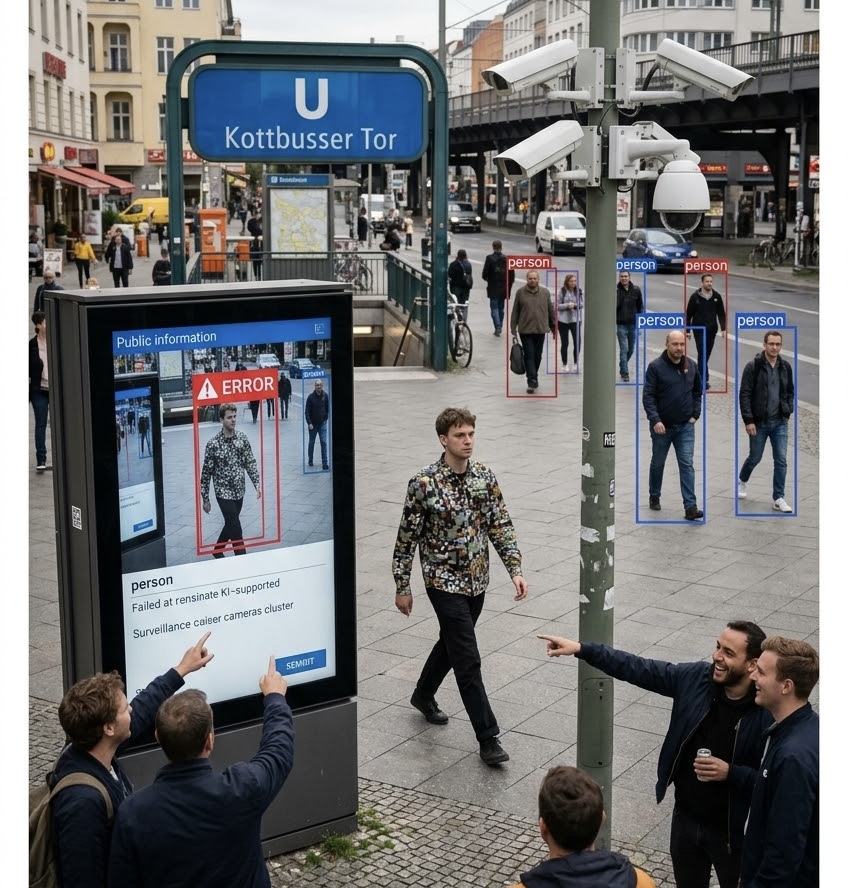
A recently presented project by artist Simon Weckert has focused attention on the vulnerabilities of contemporary video surveillance. Under the name “Digital Camouflage,” Weckert offers a patterned shirt that, according to his documentation, is intended to mislead AI‑based object detection algorithms. The project is publicly demonstrated and documented, including photographs and videos taken at Kottbusser Tor in Berlin — a location where a pilot for AI‑assisted surveillance has been launched.
The story was carried in several European outlets in late August 2026; the basic claims are supported by Weckert’s own project page. Juxtaposed with the local policy context — the Berlin pilot at the so‑called “Kotti” — the work raises questions around technical robustness, civil oversight, and legal regulation. The account below summarizes what has been verified, outlines the technical background and explores the implications for public debate about surveillance technology.
- Artist Simon Weckert published the “Digital Camouflage” project featuring a patterned shirt intended to confuse AI detectors, according to his project page.
- Weckert documented tests at Berlin’s Kottbusser Tor and states that the pattern was developed against an open object‑detection model (YOLO).
- A pilot for AI‑assisted video surveillance at Kottbusser Tor began in August 2026, as reported by Tagesschau and other outlets.
- European media reported on the project and demonstrations in late August 2026; the shirt and project site are publicly accessible.
What is “Digital Camouflage”?
"Digital Camouflage" is, according to the artist, a garment featuring a specific pattern developed in an adversarial loop against an open‑source object detection model. Weckert describes the process on his website, where photographic and video documentation of tests in Berlin can be found. The shirt is offered commercially through the project site that accompanies the research and design work.
The name borrows from military camouflage but transfers the notion to the digital observation layer: not to deceive the human eye but to confuse automated classifiers. In the presented demonstrations, a wearer of the pattern is reportedly not classified by a widely used open‑source detector — specifically YOLO (You Only Look Once) — as a recognisable person or object, according to the project’s documentation.
Technical approach and the scope of tests
The available sources indicate the pattern was created through an iterative adversarial process against an open implementation of YOLO. YOLO and its variants are commonly used in research and production for real‑time detection; adversarial patterns can trick certain models by altering input data so that the statistical features the model relies on no longer yield the correct classification.
It is crucial to specify the testing conditions: the documented tests refer to a particular implementation of YOLO in controlled settings and to recorded imagery. There is no verified large‑scale study demonstrating that the shirt consistently makes people or particular objects invisible across multiple camera angles, lighting conditions, or against up‑to‑date production models. Adversarial strategies are often highly specific to model architecture, training data distributions, or camera pipelines.
Context: the Berlin pilot at Kottbusser Tor
The choice of test location is not accidental: Berlin has been running a pilot for AI‑assisted video surveillance at Kottbusser Tor since August 2026, as reported by Tagesschau. The government‑backed pilot aims, among other things, to automatically detect hazardous situations and criminal acts to aid response teams. Such pilots have swiftly provoked public debate about purpose limitation, data minimisation and the error‑proneness of automated systems.
The conjunction of artistic intervention and a real‑world policy experiment makes the stakes tangible: if a pattern can reliably confuse detectors, it suggests both potential protective strategies for individuals and a need for security agencies to audit and adapt their systems. How police and operators responded was not fully documented at the time of reporting.
Implications for surveillance, privacy and policy
The demonstration of potential weaknesses has several, partly opposing implications. For privacy advocates, the existence of exploitable vulnerabilities supports arguments against placing excessive trust in surveillance systems. If operators present these systems as objective and infallible, demonstrable failure modes undercut that narrative. At the same time, the knowledge of countermeasures can provoke a defensive response: system operators might harden detectors by using model ensembles, fusing multiple sensor modalities (such as radar or infrared) or insisting on greater human oversight.
Politically, these findings can strengthen demands for independent audits and routine testing of surveillance systems. Regulators are increasingly pressed to require transparency on sensitivity, false‑positive and false‑negative rates and on bias in detection algorithms. While those debates are not new, a concrete demonstration in an environment where authorities are experimenting with the technology makes the discussion both more immediate and more urgent.
Remaining uncertainties and possible developments
Several questions remain unanswered. First, how generalisable is the effect? Adversarial patterns often work only against particular models, training regimes or camera setups. Second, how practical is the shirt for everyday use? Visibility, social acceptance and wearer comfort affect whether people would adopt such protective measures. Third, how will operators react? Potential responses include retraining models, deploying detector ensembles, increasing multi‑sensor fusion, or expanding human verification.
Finally, the legal status of intentional concealment varies with jurisdiction and context: deliberately evading surveillance can carry legal consequences depending on intent and situation. What the reports and the project page reliably document is a technical experiment with political resonance rather than a universal solution to surveillance. The direction of the debate will depend on follow‑up tests by independent researchers and on how policymakers and enforcement bodies respond to verified vulnerabilities.
IO SYNTHESIS
THREE-SOURCE ARTICLE ANALYSIS
Artist Simon Weckert published the “Digital Camouflage” project featuring a patterned shirt intended to confuse AI detectors, according to his project page.
OPEN EVIDENCE ↗Weckert documented tests at Berlin’s Kottbusser Tor and states that the pattern was developed against an open object‑detection model (YOLO).
OPEN EVIDENCE ↗A pilot for AI‑assisted video surveillance at Kottbusser Tor began in August 2026, as reported by Tagesschau and other outlets.
OPEN EVIDENCE ↗✓ SOURCES AND DOCUMENTS
01 derstandard.at ↗02 derstandard.at ↗03 geekblog.net ↗Sources last checked · 30.08.2026, 21:38This article was written and checked by the ZEITUNG.IO newsroom. It is updated when new verified information becomes available.